Dmitry Lvov
CV

Medical AI researcher

Dmitry Lvov

I build and test models for medical imaging. In recent work, I’ve studied how earlier exams affect radiology reports and how to predict a radiologist’s gaze.

Innopolis University
AI in Medicine Lab
Portrait of Dmitry Lvov

Selected research

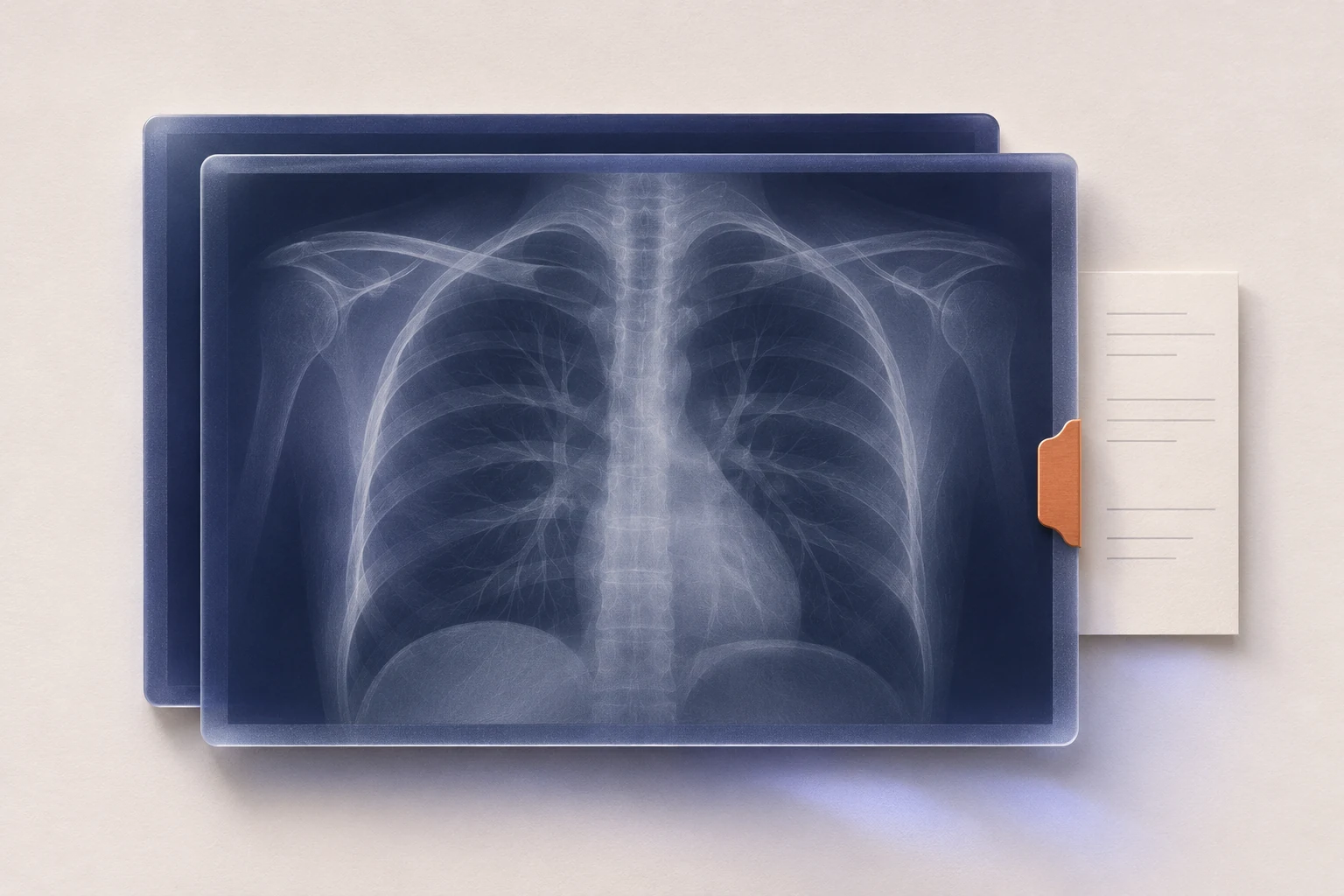
Concept illustration of two image films and a report from an earlier exam

SCFR · NeurIPS 2026 main track

See which findings change when the model reads an earlier report alongside the same X-ray.

Concept illustration of an optical lens and attention points

LogitGaze-Med · NeurIPS 2025 main track

We used patch-level signals from a medical vision-language model to predict gaze.

Concept illustration of a glass slide and four selected tissue patches

Journal of Pathology Informatics · 2026

We examined the regions that received the most attention in a whole-slide model.

Generated illustrations.

Conference talk

Publications

Main-track conference papers

  1. 2026

    Dmitry Lvov, Ilya Pershin

    Accepted at NeurIPS

  2. 2025
    From Human Attention to Diagnosis: Semantic Patch-Level Integration of Vision-Language Models in Medical Imaging

    Dmitry Lvov, Ilya Pershin

    Advances in Neural Information Processing Systems 38

Journal articles

  1. 2026
    From whole-slide prediction to compact visual evidence: Spatial and functional assessment of attention-selected patches

    Dmitry Lvov, Matvei Trifonov, Daria Galushko, Ilya Pershin

    Journal of Pathology Informatics, 100763

  2. 2026
    Enhancing Technical Question Answering Quality Through Multimodal Document Segmentation

    Dmitry Lvov, I. Smirnov, V. Volokha, A. Laushkina, A. V. Boukhanovsky

    IEEE Access 14, 12733–12743

  3. 2025
    Uncertainty Estimation in Cardio Landmark Detection and Heart Disease Diagnosis on Chest X-Ray Images

    D. Lvov, I. Stebakov, A. Kornaev, I. Pershin, T. Mustafaev, D. Afonchikov, R. Kuleev, I. Bariev, B. Ibragimov

    IEEE Access 13, 87229–87240

  4. 2025
    Automatic Calculation of Cardiometric Coefficients on Chest X-Ray Images

    A. Kornaev, D. Lvov, I. Pershin, S. Kiselev, D. Afonchikov, I. Bariev, B. Ibragimov

    IEEE Access 13, 10702–10712

Workshop papers (3)
  1. 2026
    Similar Scores, Different High-Risk Episodes: Auditing Model Selection in Longitudinal EHRs

    Polina Korobeinikova, Dmitry Lvov, Ilya Pershin

    Can We Trust AI Evaluation? · NeurIPS workshop

  2. 2026
    Same Top Fraction, Different Workload: Auditing Eligibility and Capacity in Clinical Risk Evaluation

    Vache Oganisyan, Dmitry Lvov, Ilya Pershin

    Can We Trust AI Evaluation? · NeurIPS workshop

  3. 2025
    LogitGaze: Predicting Human Attention Using Semantic Information from Vision-Language Models

    Dmitry Lvov, Ilya Pershin

    Reasoning and Planning for Large Language Models · ICLR workshop

Experience

Research and engineering

Innopolis UniversityOct 2023 – present

Researcher · AI in Medicine Lab

I design experiments for chest X-ray models and work with radiologists to evaluate the results. I advise students on clinical machine learning projects and review their code and manuscripts.

ITMO UniversityDec 2024 – present

Part-time engineer · Mind Lab

I built a pipeline for answering questions about technical documents. It finds page elements, pairs figures with captions and uses a vision-language model to describe the figures. The work became my master’s thesis and an IEEE Access paper.

Academic service

Reviewer, NeurIPS 2026.

Education

ITMO University2024 – 2026

MSc with honours in Applied Mathematics and Computer Science (Big Data and Machine Learning programme).

ITMO Best Graduate 2026.

Kazan Federal University2020 – 2024

BSc in Applied Mathematics.

NeurIPS 2025 main track

LogitGaze-Med

I worked on extracting patch-level signals from a medical vision-language model to predict where radiologists look. We tested whether those predictions helped train a pathology classifier.

ScanMatch on GazeSearch

Target-present trials. Higher scores mean closer agreement with the recorded scanpath.

LogitGaze-Med 0.419
GazeSearch baseline 0.332

LogitGaze-Med scores 0.087 higher.

The chart uses the CheXNet results from Table 1. Both models received the first fixation.

NeurIPS 2026 main track

SCFR

I led the experiments. We kept the current X-ray fixed, changed the history available to the model and checked which findings changed in its reports.

Full public radiograph used as context in Figure 1 of the SCFR paper
Same current image. Stillwaterising, CC0.
Illustrative excerpt from Figure 1 No pleural effusion.
How SCFR selects a report

Two rerankers and two finding verifiers produce alternative reports. The final router uses the report based on the current X-ray as a reference. It returns one candidate unchanged.

Journal of Pathology Informatics · 2026

From slides to selected patches

We checked where the attention-selected patches lie on the slide and what they contribute to the model’s prediction.